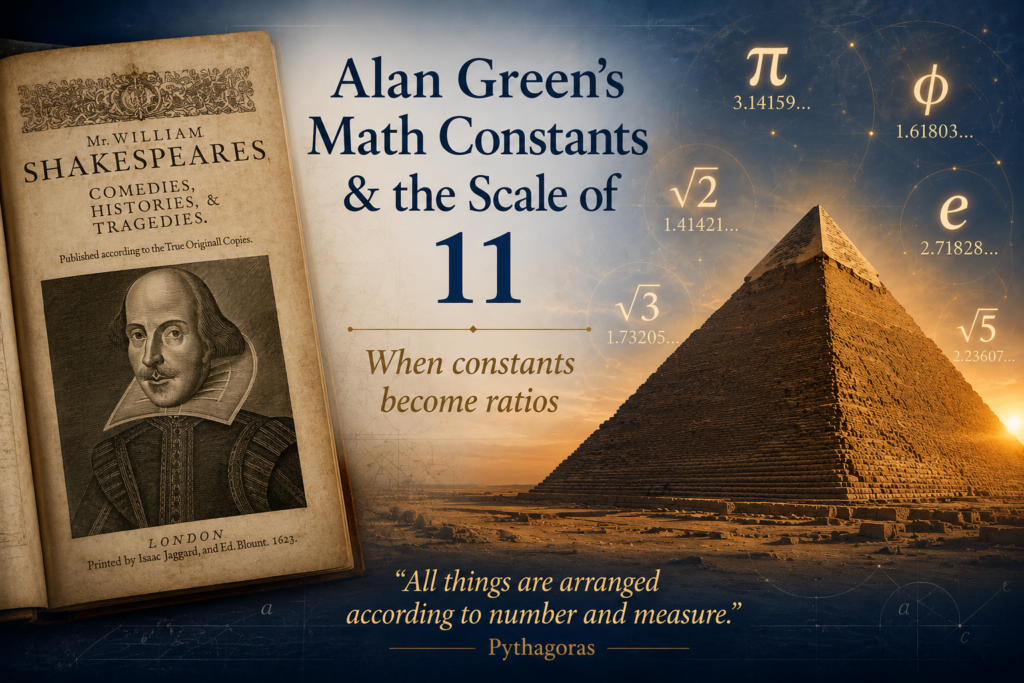
Alan Green’s Math Constants & the Scale of 11
When constants become ratios.
“All things are arranged according to number and measure.”
— Pythagoras
Alan Green has identified a series of mathematical constants that he believes are encoded within both the Shakespearean works (Title page of the First Folio) and the Great Pyramid. Among these are familiar constants such as π, φ, e, √2, and √3, along with several lesser-known constants. To review his work see: Tobeornottobe.org
While examining these constants, I became curious whether they could also be expressed through ratios arising naturally within the Scale of 11. Because the Scale of 11 generates a large family of harmonic ratios, it provides an opportunity to compare these mathematical constants within a consistent musical and numerical framework.
The question explored in this article is simple: How closely can Alan Green’s published mathematical constants be approximated by Scale of 11 ratios?
The results show that every published constant examined can be represented by a close Scale of 11 ratio.
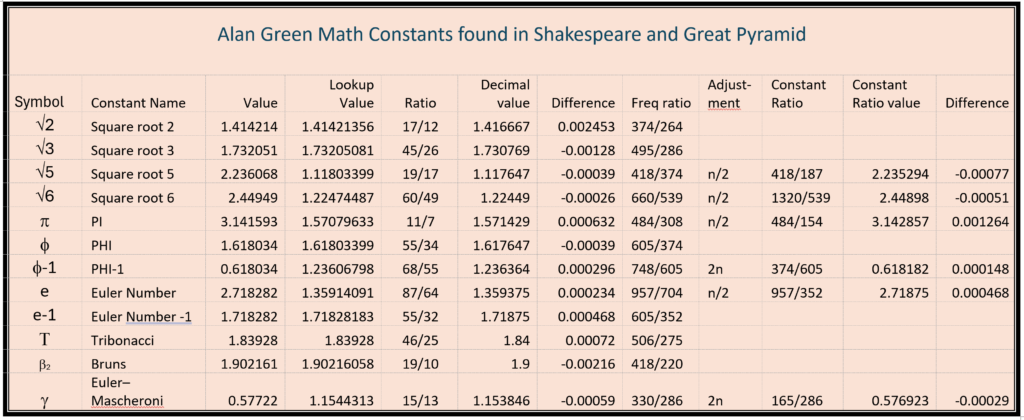
Notice that the Euler–Mascheroni constant is approximately equal to the inverse of √3 (1/√3 = 0.57735).
I found two of his findings very interesting so I thought I would share them.
The Royal Cubit and e−1
Alan observed that the Royal Cubit corresponds closely to e−1 in feet.
The Scale of 11 also produces a close harmonic approximation to e−1 and the approximate ratio is 55/32.
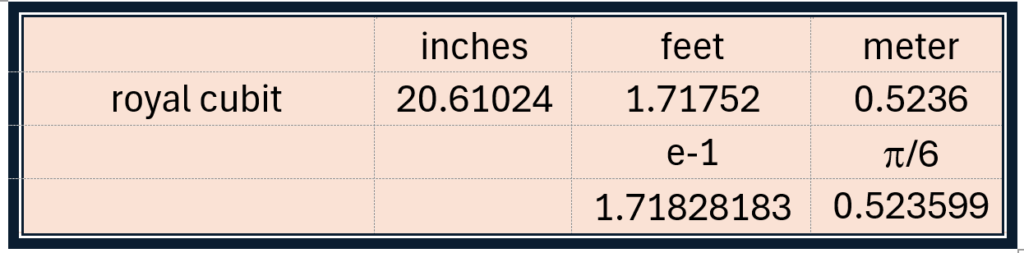
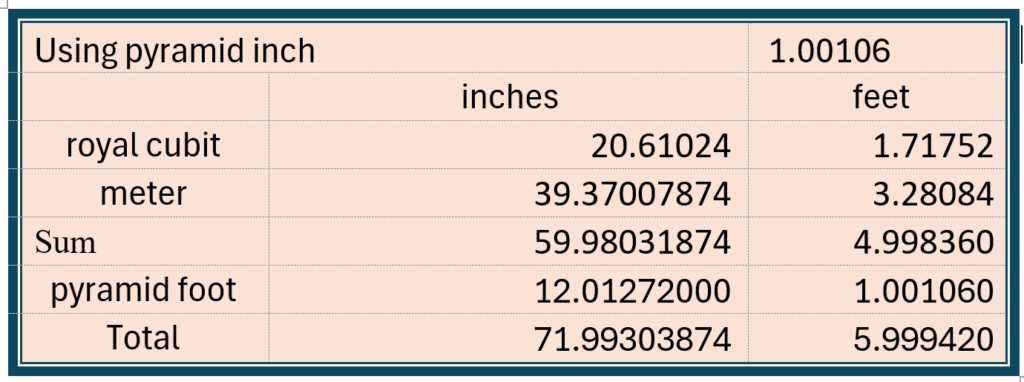
Royal Cubits – Feet and Meters and e-1
Adding the royal cubit and the meter, we arrive at a close approximation of 5 feet, expressed in both inches and feet. If we add the foot to that sum, we get a total of almost 6 feet in both inches and feet. This shows a strong correlation between the Royal Cubit, the Meter and the Foot.
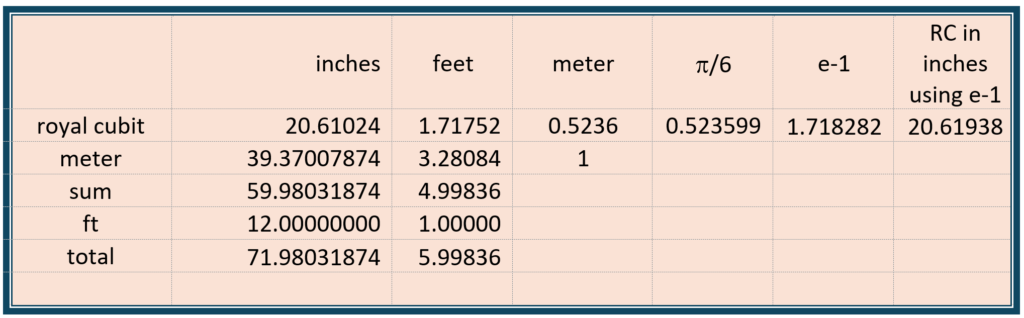
Using the pyramid inch proposed by Charles Piazzi Smyth the numbers come even closer to the 6 foot value.
Great Pyramid and e
The side-slope triangle (AFH) consists of two side-slope right triangles (AFX and AHX). This triangle is not referenced often but becomes the basis for calculating the value of e.
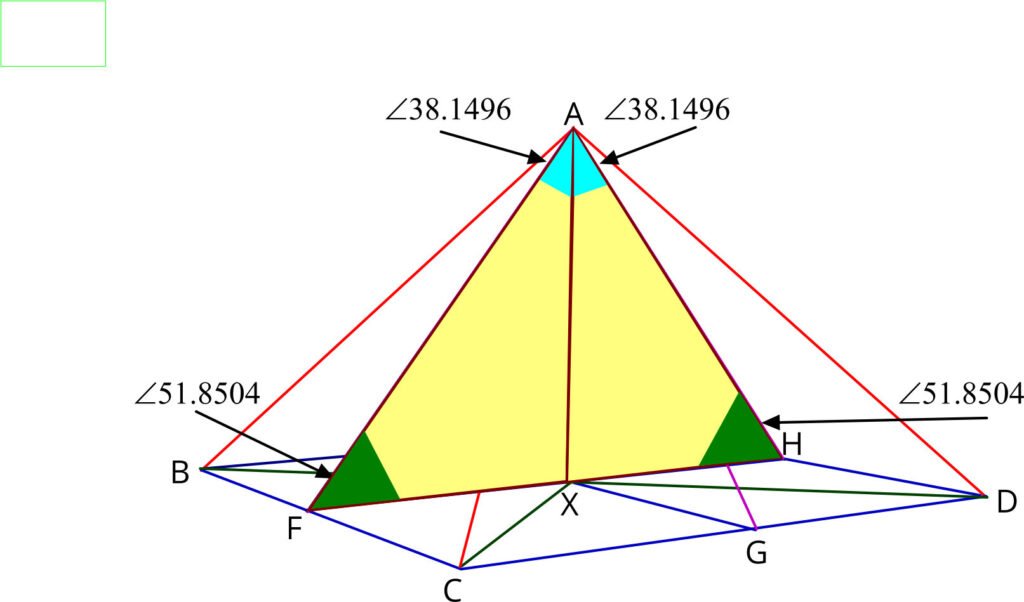
The side-slope angle (measured, green) is 51.8504°, therefore the apex angle (blue) is 38.1496°.
Divide the green angle by the blue angle (51.8504/38.1496) = 1.359128.
Now multiply the result by 2 (there are 2 triangles) and you get 2.718256 which is e.
(The actual value of e = 2.71828 so this is accurate to almost 5 decimal places.)
The relationships described above suggest a remarkable level of mathematical sophistication within the Great Pyramid’s geometry and measurement system. This begs the question: What happened to all of this knowledge? It seems like civilizations lost this knowledge over time because of famine, floods, fire, or some other catastrophic event where civilization had to reboot. Whether intentional or coincidental, these relationships have been preserved within a structure that has endured for thousands of years.
Every published constant examined can be represented by a close Scale of 11 ratio. The Scale of 11 produces simple harmonic ratios that closely approximate many mathematical constants.