Deriving Grant’s Harmonic Ratios
Through the Scale of 11
From Observed Correspondence to Generative Structure
“The laws of nature are but the mathematical thoughts of God.”
— Euclid
Robert Edward Grant presents a range of ratios associated with musical intervals and geometric relationships. While these ratios are compelling, the framework through which they arise invites further examination.
This article explores how these same ratios can be identified within the Scale of 11, where they emerge naturally from a consistent mathematical structure.
Robert Edward Grant describes a uniquely tuned system based on a 24-note quartertone chromatic scale, derived from precise temperament approaches centered around 432.081 Hz and 528.099 Hz. His work presents a range of ratios associated with musical intervals and geometric relationships, particularly in relation to pyramid structures. See full article.
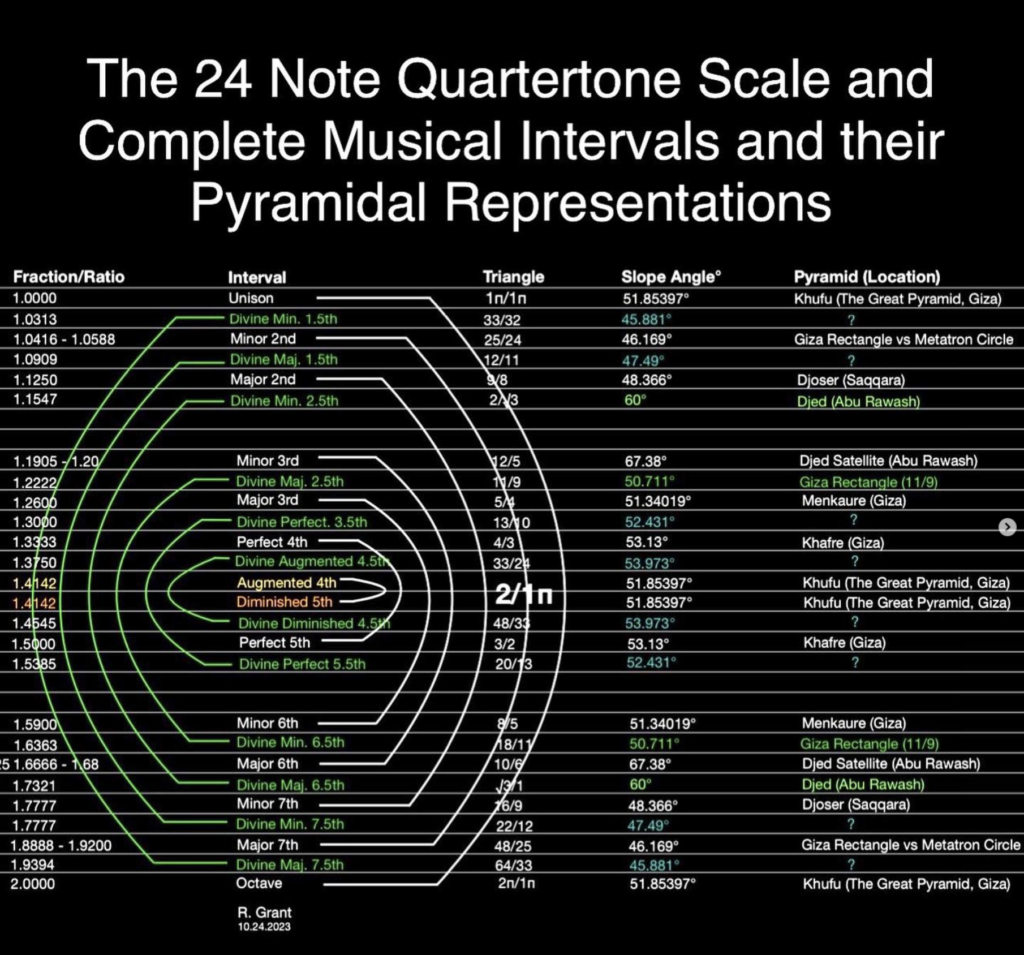
This article explores whether those same ratios can be identified within the Scale of 11, a system generated through a consistent mathematical structure based on multiples of 11.
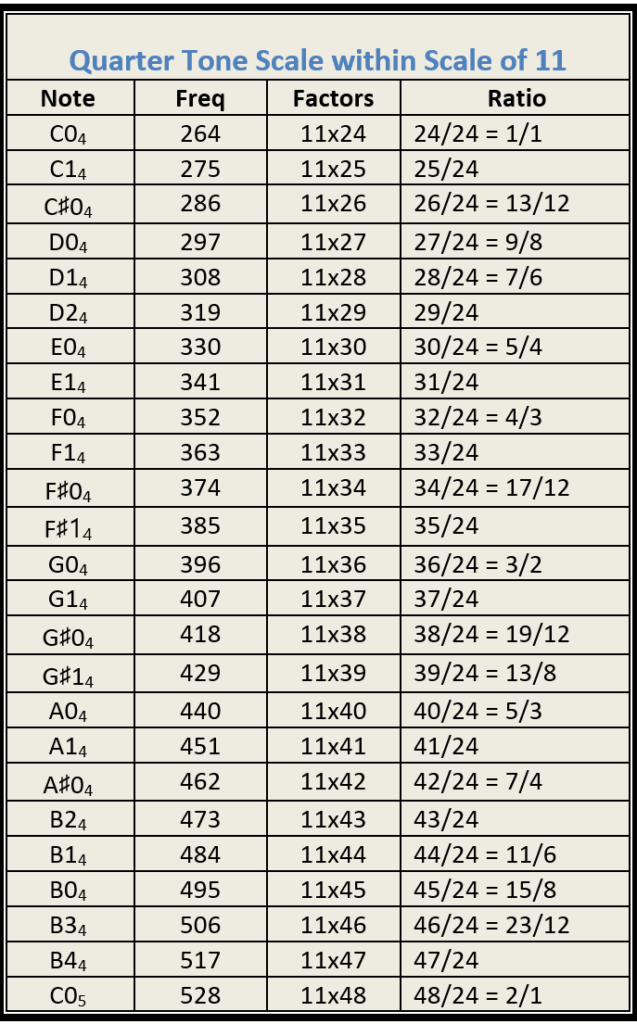
Scale of 11 Quartertone Scale
The Scale of 11 produces a quartertone framework in which each note is derived from a linear progression in the fourth octave (264 + 11n), and ratios are expressed relative to a base frequency of 264 Hz. When these ratios are normalized, a complete 24-step structure emerges, closing cleanly at the octave (2/1).
Upon examination, the ratios presented in Grant’s work can be identified within this Scale of 11 structure. In most cases, these relationships are observed by comparing middle C (264 Hz) to other notes in the system. In some instances, ratios emerge through relationships between other note pairings.
A key distinction between the two approaches lies in methodology. Grant presents observed correspondences, often linking ratios to pyramid structures without specifying measurement details such as units, reference points, or source data. The Scale of 11, by contrast, provides a generative framework in which ratios arise directly from the structure itself, allowing for verification and repeatability.
Another important distinction concerns the treatment of intervals such as the augmented fourth and diminished fifth. In many systems, these are treated as equivalent (enharmonic). However, within the Scale of 11, these intervals resolve to distinct ratios, separated by one step of the 24-division structure. This distinction reveals additional granularity within the system.
Grant also incorporates irrational constants such as √2 and √3. While these values cannot be expressed exactly as ratios, they can be closely approximated. Within the Scale of 11, several rational approximations align closely with these values, demonstrating that such relationships can emerge naturally from the structure.
Within bounded harmonic systems, irrational constants cannot be represented exactly, but highly accurate rational approximations naturally emerge through interval relationships.
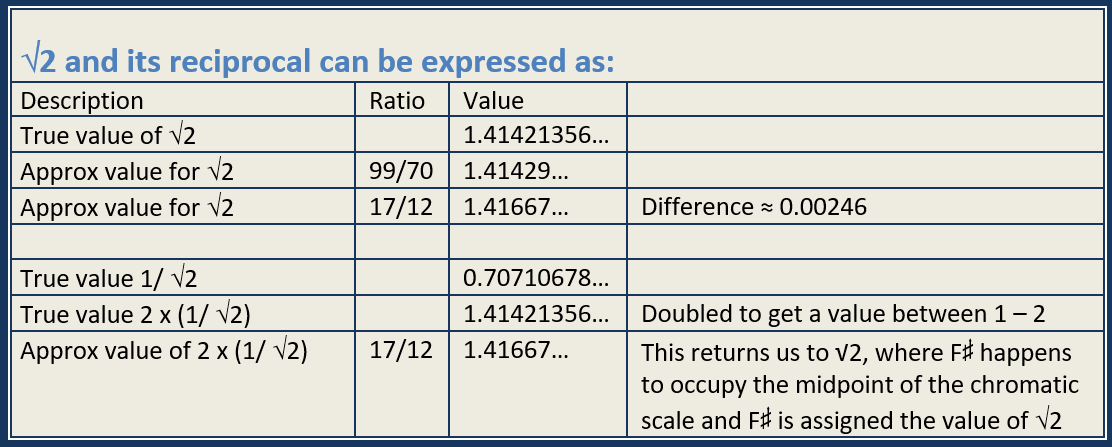
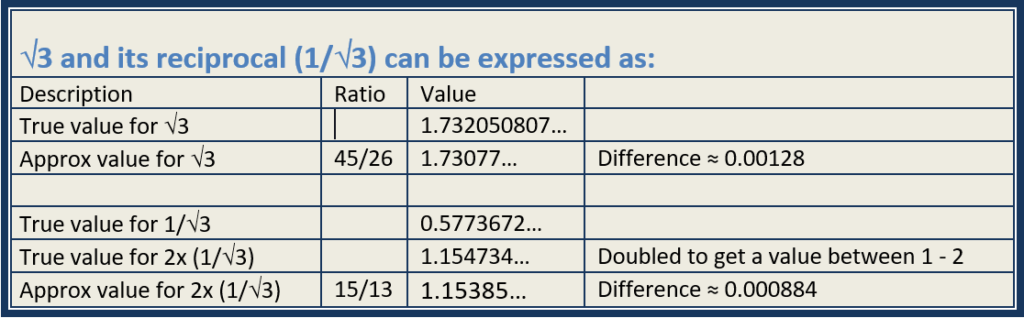
The following table summarizes how these interval relationships appear within the Scale of 11 when expressed through direct frequency ratios.
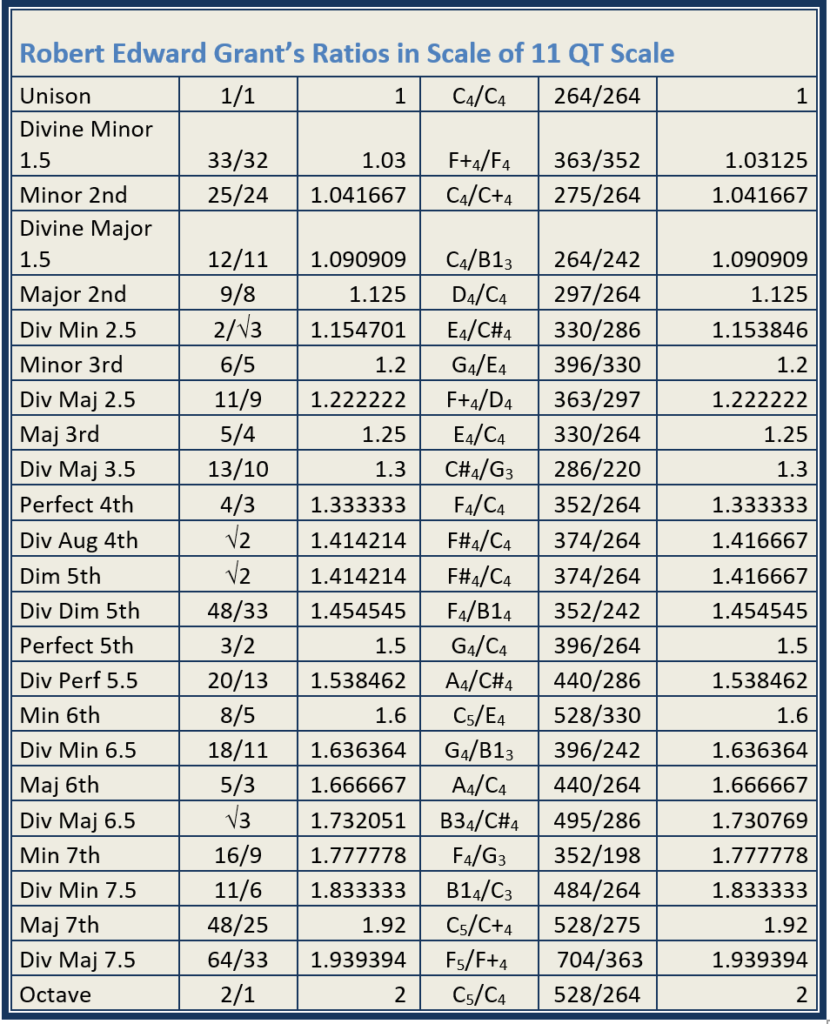
* F#, augmented 4th and diminished 5th are not the same value, augmented +1/24, diminished -1/24
Octave is denoted with the subscript
The + denotes the micro tone (+11 to the tone)
B1= 121= 11×11, first B to show up in building the Scale of 11
B2 = 253, the second B to show up in building the Scale of 11
B3 = 495, the third B to show up in building the Scale of 11
B4=517, the fourth B to show up in building the Scale of 11
To understand the building of the Scale of 11 see my article.
Read: The Scale of 11 and the RJS System.
The findings suggest that the ratios presented in Grant’s work are not isolated occurrences but may instead be part of a broader mathematical framework. The Scale of 11 offers one such framework, in which these relationships arise systematically rather than incidentally.
This does not diminish the significance of Grant’s observations. Rather, it provides a complementary perspective—one that supports, clarifies, and extends the understanding of these ratios through a consistent generative model.
Further exploration may reveal deeper connections between harmonic systems, mathematical constants, and geometric structures. The Scale of 11 serves as a foundation for that ongoing investigation.
This is not a reinterpretation of existing work, but a structural framework through which these relationships can be derived, observed, and verified.